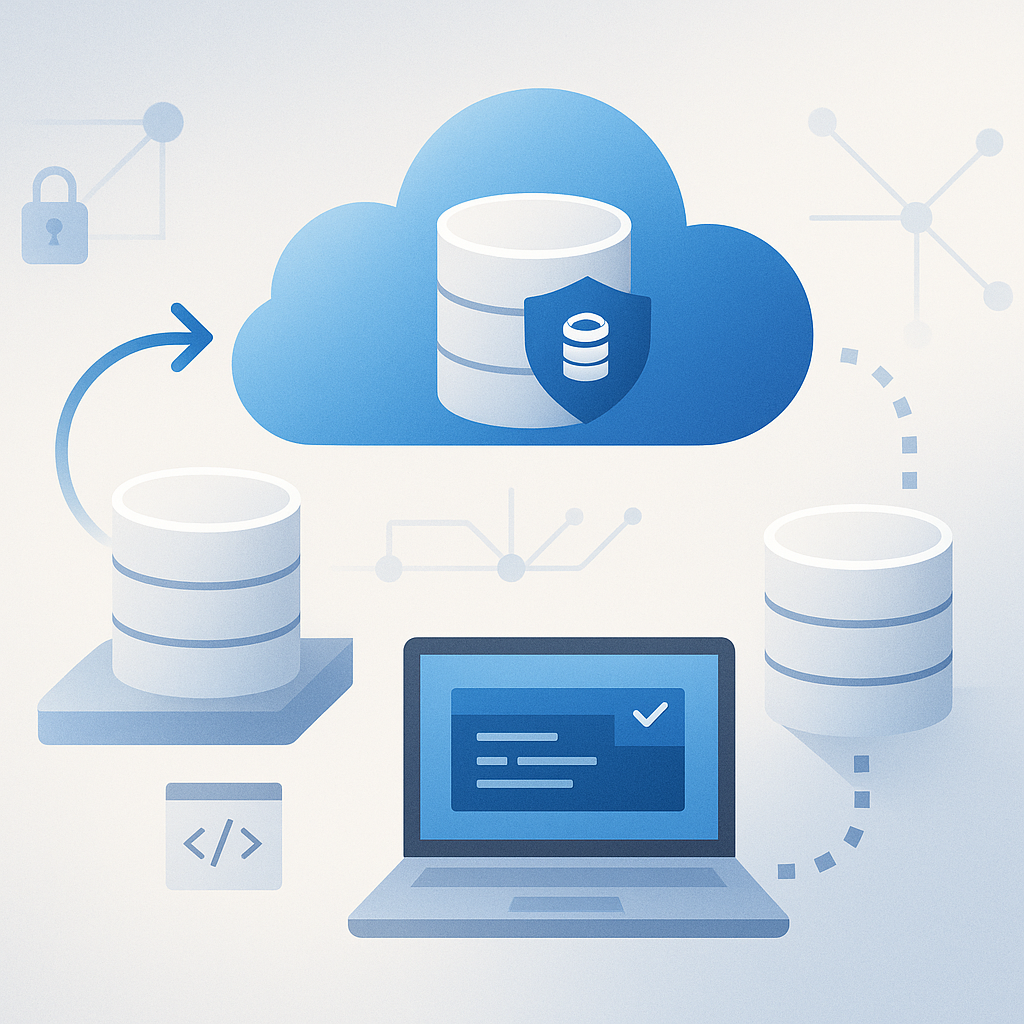
Migrating a production database is rarely about the mechanics of copying data. The hard part is meeting operational constraints: a tight maintenance window, strict security controls, unknown application dependencies, and the need to prove to stakeholders that performance and correctness are preserved. When your target is Azure SQL, you also need to decide which Azure SQL deployment option fits your workload, because that choice determines which migration methods are available and how close the destination behaves to your current SQL Server instance.
This guide walks through how to migrate to Azure SQL with minimal downtime in a way that system engineers can execute and defend in change review. It focuses on repeatable preparation (inventory, compatibility, performance baselines), clear target selection (Azure SQL Database vs Azure SQL Managed Instance), and practical migration paths (online vs offline) using Microsoft-supported tooling such as Azure Database Migration Service (DMS) and backup/restore patterns. Along the way, you’ll see how to plan the cutover so that “minimal downtime” is achieved by design rather than by luck.
Understand Azure SQL options and why the target choice drives downtime
“Azure SQL” is an umbrella term commonly used for multiple managed offerings. The two most common migration targets are Azure SQL Database (a fully managed database-as-a-service at the database level) and Azure SQL Managed Instance (a managed instance that is closer to SQL Server in terms of surface area and instance-level features).
The reason this matters for minimal downtime is that the closer the destination matches your source feature set, the fewer surprises you encounter at cutover, and the more likely you can use migration methods that support continuous data movement up to a short final cutover.
Azure SQL Database: database-level service with strong PaaS constraints
Azure SQL Database is optimized for cloud-native or modernized workloads. You manage a logical server, databases, and features like elastic pools, but you do not manage the underlying OS or SQL Server instance. Some SQL Server features that rely on instance-level behavior (for example, SQL Server Agent jobs) do not map 1:1, and cross-database dependencies are constrained.
For minimal downtime, Azure SQL Database can be a great destination when your application already uses a single database (or is being refactored to do so), and when you can accept or design around PaaS limitations. Migration methods often involve schema/data moves and then a short cutover, but “online” continuous replication options are more limited than for Managed Instance.
Azure SQL Managed Instance: closer to SQL Server for lift-and-shift
Azure SQL Managed Instance is designed for compatibility with SQL Server workloads that need instance-level constructs. It supports many SQL Server features and behaviors that are common in enterprise environments, making it a frequent choice for minimizing migration risk.
From a downtime perspective, Managed Instance is often the more forgiving destination for “minimal downtime” goals because it supports migration approaches that keep the target in sync until the final cutover, and it reduces rework around features like SQL Agent, linked servers (with caveats), and other instance-level capabilities.
Real-world scenario #1: strict change window and SQL Agent reliance
A manufacturing company has a 30-minute weekly maintenance window and a SQL Server instance that runs dozens of SQL Agent jobs for ETL and reporting. They want to reduce operational overhead but cannot rewrite the job ecosystem immediately.
In this scenario, migrating to Azure SQL Managed Instance typically keeps the job model closer to the source. The minimal downtime strategy focuses on keeping data synchronized (via an online migration approach) and rehearsing a cutover where the application connection string flips quickly, while jobs are validated and re-enabled in the target.
Define “minimal downtime” in measurable terms
Minimal downtime means different things to different teams. For a database migration, you should translate it into measurable objectives:
Downtime is the interval during which the application cannot reliably read/write the database in production. In practice, you should define both the “hard” outage (service unavailable) and the “soft” outage (writes frozen or delayed).
A useful way to operationalize this is to define two numbers:
- Maximum write unavailability: how long the application can tolerate write blocking or read-only mode.
- Maximum data loss (RPO): acceptable data loss in seconds/minutes (ideally zero). Minimal downtime migrations usually target near-zero RPO at cutover.
These metrics determine whether you need an online migration method (continuous sync) or whether an offline method (single copy with a longer cutover) is acceptable.
Inventory the source: dependencies, features, and constraints you must not discover late
Before selecting a tool, you need a reliable inventory of what you’re moving. Downtime surprises usually come from dependencies you didn’t know existed or features that are not supported in the target.
At minimum, identify:
- Database size and growth rate.
- Peak write throughput and transaction log generation rate.
- SQL Server version/edition and patch level.
- High availability setup (Always On availability groups, failover cluster instance, log shipping, etc.).
- Security model (SQL logins, Windows logins, groups, certificate-based features).
- Features in use: CLR, Service Broker, replication, SSIS/SSRS dependencies, cross-database queries, SQL Agent jobs, linked servers.
Use Microsoft tooling for discovery without guessing
Microsoft provides assessment tooling through Azure Migrate (Data Migration Assistant / migration assessment features) and related discovery methods. The goal is to produce a compatibility report and a list of remediation tasks.
For SQL Server, the key is to identify blocking issues early: unsupported features, collation differences, and cross-database dependencies that might force you toward Managed Instance.
You can also use basic T-SQL queries to inventory common constructs. For example, to find SQL Agent job usage you’ll typically query msdb on the source instance. Since those queries are environment-specific and involve msdb schema, treat them as supplementary to assessment tooling rather than a complete approach.
Baseline performance so you can validate “no regression” after cutover
Minimal downtime isn’t valuable if performance regresses and you spend the next week firefighting. Before migration, capture a baseline:
- CPU, memory, disk latency, and throughput on the source.
- Key query latency (p95/p99 if possible) and top resource-consuming queries.
- Wait statistics and log write latency.
If you’re using Query Store on SQL Server (2016+), it can help you compare query behavior before and after migration, but even without it, capturing top queries and their plans creates a sanity reference.
Choose the migration path: online vs offline based on downtime and complexity
With inventory in hand and a target selected, choose a migration method that matches your downtime target.
Online migration: keep data syncing until a short cutover
An “online” migration keeps the target database synchronized while the source continues to serve production traffic. At cutover, you stop writes on the source, let the target catch up, and then flip the application.
Online migration is how you reliably achieve minimal downtime, but it requires more prerequisites: connectivity, permissions, and sometimes specific SQL Server configurations.
Offline migration: simpler, but downtime equals copy time plus validation
Offline migration moves schema and data in one operation, and the application is typically down (or in read-only mode) during the migration window. This can be acceptable for smaller databases or workloads where a longer outage is permitted.
Even with offline migration, you can reduce downtime with preparation: pre-create the target, pre-provision logins/users, validate schema, and rehearse the final copy process.
Real-world scenario #2: small line-of-business database with weekend downtime
A regional services firm has a 120 GB database supporting an internal app. The business allows a four-hour outage on Saturday night. The workload is steady but not high-throughput.
Here, an offline migration may be the lowest-risk path, because the operational overhead of continuous sync might not be worth it. The minimal downtime objective is met by rehearsing the offline move to fit comfortably within the four-hour window and by validating the app quickly after cutover.
Design the target landing zone: networking, identity, and governance first
Migration projects fail late when networking and identity are treated as afterthoughts. Azure SQL access patterns differ from on-premises SQL Server, and “it works from my laptop” is not a production readiness signal.
Networking choices: public endpoint vs private connectivity
Azure SQL supports public connectivity with firewall rules, but many enterprises require private connectivity.
For production migrations, you typically choose one of these patterns:
- Private Endpoint (Private Link) for Azure SQL Database or Managed Instance access over a private IP in your virtual network.
- ExpressRoute or VPN for connectivity between on-premises and Azure VNets.
For minimal downtime migrations, stable low-latency connectivity matters because online migrations replicate changes continuously. Network instability increases lag and can expand the cutover window.
DNS and name-based cutover strategies
Cutover becomes easier when applications connect using a DNS name you control rather than hardcoding server names. A common approach is:
- Create an application DNS name (for example,
sql-prod.company.localorsql-prod.company.com). - Point it at the current SQL endpoint.
- At cutover, update DNS to the Azure SQL endpoint.
This is not a silver bullet—connection strings, drivers, TLS settings, and authentication still matter—but it reduces the number of application changes required during cutover.
Identity and authentication: decide early between SQL logins and Microsoft Entra ID
Azure SQL supports SQL authentication and Microsoft Entra ID (formerly Azure AD) authentication. Minimal downtime is easier when the authentication model is consistent across source and target.
If you migrate from SQL logins, you’ll need a plan to migrate logins and map them to database users. If you move to Entra ID, you’ll need to update applications, service principals/managed identities, and role mappings.
A pragmatic approach is often to keep SQL authentication for the first migration cut and then modernize to Entra ID in a second change, unless policy requires Entra ID from day one.
Security posture: encryption and data classification considerations
Azure SQL provides encryption at rest by default (for Azure SQL Database) and supports Transparent Data Encryption (TDE) on Managed Instance as well. If you use customer-managed keys (CMK), build that into the timeline; it can add dependencies on Key Vault and access policies.
If you use Always Encrypted (client-side encryption), treat it as a special case. It changes how data is stored and accessed and can constrain migration options and validation techniques. Plan it explicitly rather than discovering it at cutover.
Prepare the source for migration: cleanup, compatibility, and operational guardrails
Once the landing zone is ready, you can prepare the source. This is where you reduce the chance of a long cutover caused by preventable issues.
Reduce churn and control change during the migration window
Online migrations are sensitive to unpredictable schema changes. Put a change freeze in place for schema changes during the replication period, or implement a controlled process where schema changes are applied to both source and target in a coordinated way.
Also consider reducing bulk operations during initial seeding. Large index rebuilds or batch ETL can generate heavy log volume, increasing replication lag.
Fix obvious schema and compatibility issues before moving data
Assessment reports often identify blockers: unsupported data types or features, cross-database dependencies, or collation conflicts.
Addressing these early has a direct effect on downtime because you avoid last-minute remediation. A migration cutover should not be the first time you discover that a critical stored procedure depends on a linked server or that the application assumes it can access multiple databases in one session.
Plan for SQL Agent jobs, SSIS packages, and external dependencies
If your source workload relies on scheduled jobs, decide what will run where after the migration. With Managed Instance, SQL Agent is available, but you still need to validate job owners, proxies, credentials, and any file-system dependencies.
If jobs call out to network shares, file paths, or local executables, you may need to redesign them to run on Azure VMs, Azure Automation, Azure Functions, or other services, even if the database itself moves to Azure SQL.
Choose the right tooling: DMS, backup/restore patterns, and when to use BACPAC
Microsoft’s migration guidance generally centers around Azure Database Migration Service (DMS) and backup/restore approaches depending on your target.
Azure Database Migration Service (DMS): orchestrated migrations
DMS is commonly used for SQL Server migrations to Azure SQL targets. It can perform offline or online migrations depending on the target and source configurations.
The operational advantage of DMS is repeatability and status visibility. For minimal downtime, the key value is its support for online migration scenarios where changes replicate until cutover.
Because DMS requirements change over time and vary by scenario (source version, target type, feature set), treat the Azure documentation as the source of truth for the specific prerequisites for your path.
Backup/restore and native copy approaches
For Managed Instance, native backup/restore approaches are frequently used because they map well to SQL Server’s backup semantics. For Azure SQL Database, backup/restore from SQL Server is not a direct 1:1 operation; instead, you commonly use logical export/import (BACPAC) or DMS-driven migrations.
BACPAC: useful for smaller or simpler databases, but not for minimal downtime
A BACPAC is a logical export of schema and data. It is straightforward and often used for dev/test or smaller databases.
However, BACPAC is typically not the right answer for minimal downtime on production workloads because it is an offline operation and can be slow for large databases. It also has limitations around what it can represent (for example, certain features and object types).
Implement an online migration to Azure SQL Managed Instance (minimal downtime pattern)
If your goal is minimal downtime and you chose Managed Instance for compatibility, an online migration pattern usually looks like this:
- Provision Managed Instance and configure networking and access.
- Validate connectivity from the DMS service (or migration host) to source and target.
- Seed the target (initial full load).
- Continuously replicate changes (ongoing sync).
- Plan cutover: stop writes, allow final sync, switch applications.
The critical idea is that the lengthy work (moving the bulk of data) happens while production runs normally. The cutover window is reserved for the last delta and validation.
Provision Managed Instance with realistic sizing (avoid under-provisioning)
Minimal downtime cutovers fail when the target is underpowered and can’t keep up during initial load or at steady state. Use your baseline to estimate:
- Compute requirements (vCores) based on CPU usage and concurrency.
- Storage and IOPS requirements.
- Log write throughput sensitivity.
For migration, you may temporarily scale up the target to speed seeding and reduce lag, then scale down after stabilization.
Networking prerequisites for Managed Instance migrations
Managed Instance is deployed into a virtual network. Ensure you have:
- Appropriate subnet sizing and delegation requirements.
- Route tables and NSGs that allow required traffic.
- Name resolution that works from your migration tooling to both ends.
From an operational perspective, test connectivity from the same network path that DMS (or your migration host) will use. Don’t assume that because an admin VM can connect, the managed service can.
Example Azure CLI: create a Managed Instance (illustrative skeleton)
Exact parameters vary by environment and policy, but the following skeleton shows the shape of a Managed Instance deployment using Azure CLI:
# Variables

RG="rg-data-prod"
LOC="eastus"
VNET="vnet-data-prod"
SUBNET="snet-sqlmi"
MI="sqlmi-prod-01"
ADMIN_USER="sqladmin"

# Create resource group

az group create -n "$RG" -l "$LOC"

# Create managed instance (parameters are illustrative; tune for your requirements)

az sql mi create \
  -g "$RG" \
  -n "$MI" \
  -l "$LOC" \
  --admin-user "$ADMIN_USER" \
  --admin-password "<use-a-secure-secret>" \
  --subnet "/subscriptions/<sub>/resourceGroups/$RG/providers/Microsoft.Network/virtualNetworks/$VNET/subnets/$SUBNET" \
  --license-type BasePrice \
  --storage 1024 \
  --vcores 8
Treat this as a starting point for automation, not a copy/paste production script. In regulated environments you’ll also integrate Key Vault, private DNS zones, and policy-driven tagging.
Keep logins and users consistent to reduce app changes
Application downtime often extends because authentication breaks. Plan the mapping between server-level principals (logins) and database users.
If you are staying with SQL logins, ensure you can recreate logins on the target with appropriate SIDs so database users map cleanly. If you change identities, plan to update connection strings and permissions ahead of cutover.
Real-world scenario #3: healthcare app with audit requirements and near-zero RPO
A healthcare provider runs a patient scheduling system on SQL Server with strict audit controls. They require near-zero data loss and can tolerate only a few minutes of write unavailability overnight.
In this scenario, the minimal downtime strategy is to use an online migration pattern to Managed Instance, keep the authentication model stable for the initial move, and pre-stage auditing and security settings. The cutover is executed during a controlled write freeze, with application-level validation focusing on audit trails and stored procedure behavior.
Implement a migration to Azure SQL Database (when PaaS constraints fit)
When the application is already aligned with database-level isolation, Azure SQL Database can be the best long-term operational fit. The minimal downtime mechanics are different because the service model differs.
A common successful pattern is:
- Migrate schema and data to Azure SQL Database.
- Validate compatibility and performance.
- Cut over by switching the application endpoint.
Depending on the source and chosen tooling, you may be able to reduce downtime by pre-staging the bulk of data and limiting the cutover to a final delta load. The practicality of that approach depends heavily on how frequently data changes and what tools you use.
Right-size Azure SQL Database for the cutover period
Azure SQL Database has multiple purchasing models (DTU-based and vCore-based). For minimal downtime migrations, you care about two phases:
- Load phase: needs throughput for bulk insert and index creation.
- Steady state: needs consistent performance for production.
It is common to scale up temporarily for migration and then scale down after you validate workload performance.
Example Azure CLI: create an Azure SQL Database (vCore model)
bash
RG="rg-data-prod"
LOC="eastus"
SERVER="sqlsrv-prod-01"
DB="appdb-prod"
ADMIN_USER="sqladmin"

az sql server create \
  -g "$RG" -l "$LOC" \
  -n "$SERVER" \
  -u "$ADMIN_USER" \
  -p "<use-a-secure-secret>"

# Create database (example uses General Purpose; choose tier based on baseline)

az sql db create \
  -g "$RG" \
  -s "$SERVER" \
  -n "$DB" \
  --service-objective GP_S_Gen5_4 \
  --zone-redundant false
In production, you will typically pair this with private endpoints, firewall rules scoped to required networks, and Entra ID configuration.
Build a cutover plan that is engineered for speed
Minimal downtime is primarily a cutover planning discipline. Your goal is to reduce cutover to a small set of deterministic steps that you have rehearsed.
A cutover plan should include:
- A precise freeze time for writes (or full outage time).
- The exact command sequence or runbook for final sync and switchover.
- Validation checks that are fast but meaningful.
- A rollback plan with clear go/no-go criteria.
Create a time-boxed runbook with owners and checkpoints
Assign an owner per step (DBA, network engineer, app owner). Time-box steps and include decision checkpoints.
The most important checkpoint is after final synchronization and before application endpoint switch. If something is wrong at this point, rollback is still relatively cheap.
Choose validation that detects real issues quickly
Validation should not be a vague “test the app.” Use a layered approach:
Start with database-level checks:
- Database online and accessible from the application network path.
- Key logins/users mapped and permissions correct.
- Critical jobs or integrations disabled/enabled as planned.
Then application-level checks:
- Smoke tests that exercise writes and reads on the most critical transactions.
- Monitoring of error rates and latency.
Finally, deeper checks can happen after cutover while you’re in a heightened monitoring window.
Data validation strategy: reconcile what matters, not everything
For large databases, validating every row is impractical in the cutover window. Instead, reconcile:
- Row counts for critical tables.
- Checksums or hashes for selected tables/partitions where feasible.
- Application-level invariants (for example, “every order has at least one order line”).
If you already have ETL or reporting systems that compute aggregates, those can be repurposed as post-cutover sanity checks.
Manage application connectivity for a clean switchover
After the data is synchronized, the application change is usually the highest-risk step. Even if the database is perfect, an overlooked driver setting or TLS requirement can extend downtime.
Update connection strings deliberately (and ideally once)
If you can centralize connection strings (for example, in a configuration service or environment variable store), you reduce cutover complexity.
For .NET applications, pay attention to encryption defaults and certificate validation. Azure SQL enforces TLS; ensure client drivers are current enough to negotiate modern TLS settings.
Connection resiliency and retry logic
Even with a perfect cutover, there may be transient connection failures as DNS updates propagate or as connection pools recycle. Ensure your application’s database client has reasonable retry logic.
This doesn’t replace a good cutover, but it can prevent a brief connection blip from turning into a prolonged outage.
Rehearse: the single most effective way to reduce downtime
If you want minimal downtime, you need at least one full rehearsal. Rehearsal reveals:
- Steps that take longer than expected.
- Permissions and firewall gaps.
- Application behaviors that weren’t documented.
A rehearsal should be as production-like as possible: similar database size (or at least representative), similar network path, and the same tooling.
Use a staged environment and capture timings
When you run the rehearsal, record:
- Initial seed duration.
- Replication lag under normal workload.
- Final synchronization time after write freeze.
- Time to switch application connectivity and restore steady state.
Those timings become the factual basis for change management approvals.
Operational readiness after cutover: monitoring, backups, and governance
Minimal downtime migrations often succeed technically but fail operationally when teams realize that routine tasks changed. Before cutover, ensure that the target has equivalent or improved operational controls.
Monitoring: ensure you can see the same signals you used on-prem
At a minimum, ensure you can monitor:
- Connectivity failures and login issues.
- CPU/worker pressure and query latency.
- Storage and log growth.
- Deadlocks and blocking patterns.
Azure-native monitoring typically involves Azure Monitor metrics, diagnostic settings, and log destinations (Log Analytics workspace, Event Hub, or storage). The exact implementation depends on your organization’s observability standards.
Backups and restore expectations
Azure SQL provides automated backups and point-in-time restore capabilities, but the restore process differs from on-prem SQL Server. Define:
- Recovery objectives (RPO/RTO) and how they map to Azure SQL features.
- Who can initiate restores and how access is controlled.
- How you test restore procedures.
If you previously relied on custom backup jobs and file-based storage, you’ll need to update operational runbooks accordingly.
High availability and disaster recovery alignment
Azure SQL includes built-in high availability within a region, but disaster recovery across regions is a separate design decision. If your current environment uses a DR site or an availability group, define the Azure equivalent (for example, geo-replication patterns) that matches your compliance and uptime goals.
This matters for migrations because DR configuration can affect cutover sequencing. Some teams choose to cut over to a single region first, validate stability, and then enable cross-region DR.
Common patterns that keep downtime low (without relying on heroics)
Across successful migrations, several patterns show up repeatedly.
Pattern: pre-provision everything that isn’t data
Anything you can set up before the cutover window reduces downtime risk:
- Target resource provisioning and scaling.
- Network paths, private endpoints, DNS.
- Logins, users, and permissions.
- Auditing, alerts, diagnostic settings.
Then the cutover window is mostly about the final sync and application switch.
Pattern: treat schema changes as a controlled pipeline
Uncontrolled schema changes during an online migration are a major downtime amplifier. If schema must change during the migration period, coordinate changes so that source and target remain compatible.
Pattern: plan rollback as an engineered option
Rollback is not a moral failure; it’s an operational safety mechanism. Define rollback triggers (for example, sustained error rate, unacceptable latency) and define how to revert application connectivity.
A rollback plan that’s been rehearsed is one of the strongest ways to keep downtime minimal, because it prevents extended indecision while teams debate what to do.
Practical cutover checklist (runbook-friendly, not a replacement for rehearsal)
A cutover should be executed as a controlled runbook with strict sequencing. The exact steps differ by tooling, but the structure is consistent.
First, confirm preconditions in the hours leading up to cutover: target health, monitoring active, required staff available, and change freeze enforced.
Second, enter the cutover window by stopping application writes. Depending on your architecture, this may mean placing the application into maintenance mode, disabling write paths, or stopping application services.
Third, complete the final synchronization according to your migration method. For online methods, this is where you ensure replication lag reaches zero and the target is consistent.
Fourth, switch application connectivity. Ideally, this is a single configuration change (DNS update or connection string update) followed by controlled restarts.
Finally, validate quickly and decide go/no-go. If validation fails and rollback criteria are met, revert quickly rather than attempting ad-hoc fixes under outage pressure.
Putting it together: an end-to-end migration narrative
To connect these pieces, consider how an IT team might execute a minimal downtime migration in practice.
They begin with assessment and discover that the source SQL Server uses SQL Agent, cross-database queries, and some instance-scoped settings. That pushes the target selection toward Azure SQL Managed Instance to reduce rework.
Next, they build the landing zone: a dedicated VNet subnet for Managed Instance, private connectivity from on-premises over ExpressRoute, and private DNS so application hosts can resolve the Managed Instance endpoint without public exposure. In parallel, they decide to keep SQL authentication for the first cut to avoid coordinating an identity change across multiple applications.
Then they prepare the source: enforce a schema change freeze, identify heavy ETL windows, and choose a migration period that avoids peak log generation. They baseline performance and capture a set of key query timings.
With the target provisioned and sized aggressively for the seeding phase, they run an online migration, allowing the bulk load to complete while production continues. During this period, they monitor replication lag and confirm that network throughput is stable.
Finally, they rehearse the cutover in a staging environment, record timings, and adjust the runbook until the write freeze plus final sync consistently fits within the allowed window. On the production cutover night, the application is placed into maintenance mode, the final sync completes, the connection endpoint is switched, and smoke tests confirm that the business-critical transactions work. After traffic resumes, the team monitors latency and errors, then scales the Managed Instance down to its steady-state sizing once stability is confirmed.
The main reason this approach delivers minimal downtime is that it treats downtime as a planned engineering constraint: the slow work happens before cutover, and the cutover is a short, rehearsed sequence with deterministic checkpoints.